
Growing up in a Methodist Church, worship meant a straight spine, turning to page 76 in my hymnal, and mouthing words to songs I didn’t know. By the time I was in college, I’d tried a 3CU church, a Pentecostal church, and a non-denominational church.
Over the years, I’ve experienced incredible communities and ministries. I’ve felt loved, accepted, and seen. But I’ve also experienced some pretty judgmental, hypocritical, and hurtful places I often wish I could erase from my memory—places that tempted me to leave Jesus and the Church altogether. If you’ve felt this way, I want you to know I’m so sorry. I’m sorry that someone acted un-Christ-like and hurt you. But I’d also beg you to remember one thing: Don’t judge Christ by those who don’t act like Him. Separating Jesus from harmful behavior does not excuse what happened, require you to remain in an unsafe church, or remove the need for accountability.
Key Points
- Finding a church can feel especially difficult when you are new to Christianity, healing from church hurt, or rebuilding your faith.
- You do not have to rush the process; prayer, patience, and honest reflection can help you evaluate a potential church home wisely.
- A healthy church should be centered on Christ and grounded in faithful, biblical teaching.
- Look for leadership marked by accountability, humility, transparency, and genuine concern for the congregation's safety and well-being.
- The goal is not to find a perfect church, but a trustworthy Christian community where you can heal, grow, worship, and be genuinely cared for.
If you’re looking for a home church when you’re new, wounded, or starting over in your faith, here are some tips, questions to ask yourself, and prayer prompts to get you started. A healthy church home will center on Jesus, teach Scripture faithfully, practice accountability, protect vulnerable people, and give you room to build trust and community over time.
How Can a New Christian Find a Church Home?
If you’re a newer Christian, I’m so excited that you’re reading this post! Having a personal relationship with Jesus Christ will change your life, but it’s not meant to be lived in isolation, and that’s why finding a good home church matters. Let’s look at some tips, questions, and prayer prompts that you might find helpful on this journey.
- Pray for God to lead you
I know it sounds cliché, but I truly believe the Lord can lead us where we’re meant to go. Don’t underestimate the power of prayer and His divine guidance! How do I know? I’ve seen it in my own life. On multiple occasions in my young adulthood, God would lead me from Church to Church. After my husband Ben and I got married and moved, we needed to find a new church yet again. I still laugh that we ended up at a church I said I’d never attend, but here we are. God has such humor, and He always knows what’s best. - Release the pressure and unnecessary expectations
The first church you attend might not be the right fit (and that’s okay). Sometimes, finding the best church for you takes time. But it’s always worth it. When looking for a good fit, remember that no church is perfect. We are human beings, and all have flaws. But truly good and beautiful places of fellowship do exist. It’s also important to recognize that some churches might just be for a season. I don’t consider myself a “Church hopper,” but the Lord has led me to 5 different churches in five different seasons. I’m thankful for each one, but I never would’ve experienced any of them without following God’s guidance during that time and season. - Determine your core values
Besides the core tenets of the faith (e.g., Jesus is the way, the truth, and the life; Jesus is God and the Holy Spirit; only Jesus saves), it’s important to make a list of what you’re specifically looking for in a church. Is it a good kids program? A specific ministry team? Mission support? These things will be unique to you. When I was looking for a Church, I wanted to find a place that understood mental health from a biblical and psychological perspective, allowed dance and the creative arts, and had welcoming, friendly people. Having this list on hand can help you discern a church service after you’ve attended it. - Do your research
It might sound simple, but you would be surprised how many people attend a church without ever looking into what they believe and who runs it. Before attending a service, check out their website, social media, staff pages, and sample sermons online (if applicable). Then, evaluate your core values in step three. - Ask a friend
If you’re not sure where to start when finding a good church, asking a friend might be more helpful than turning to Google or AI. Getting personal recommendations from family and friends and then attending a service together can be a great place to start.
Questions:
- What are your core values for a Church?
- Who can you ask to attend a new Church service with you?
- What expectations might you have for a Church? Are any of them unnecessary or unrealistic?
Prayer Prompts
- Dear God, please lead me where you want me to go. As I research and learn about Churches, my soul is stirred, and my heart speaks.
- Dear God, please show me what core values should matter to me. Am I holding onto any beliefs that are unhealthy or unhelpful? If so, help me release those to you and replace them with what you say is important.
How Do You Find a Church After Church Hurt?
Unlike new believers, if you’ve been wounded by the faith, I want you to know that I see you and I’m so sorry. Being a Christian should be the highlight of our lives. Unfortunately, living in a broken world, people hurt people. If you’re reading this post, I hope that means you still have a small spark of hope that a better community is still out there, and I’m so proud of you for choosing to show up even when it hurts. Here are some tips, questions to ask yourself, and prayer prompts to get you started.
- Take Time to Heal
I know that not everyone will agree with this, but it’s important to take time to heal and release any bitterness you might be carrying before jumping from church to church. Even if you don’t feel 100% better, leaving that pain with God is the best option. Not because it didn’t matter or because no one will ever hurt you again, but because holding on to it will prevent you from moving on to what God has for you now. Taking time to heal could look like journaling, confiding in a friend, talking to God honestly, crying, or seeking therapy, though these are just a few examples. - Give Yourself Grace
It goes without saying, but when you’ve been wounded by the Church, your walls seem to go up. That’s normal and natural. So give yourself some grace. God isn’t asking you to act a certain way or show up without feeling. It’s okay to come weary, hesitant, doubting, and hurting. What matters is that you come. - Give Yourself Permission
Though it’s going to be scary and hard, you need to permit yourself to hope again. Hope to find a good and healthy church. Hope that this is not the end. Hope that God still has a place for you in His house, because He does! Then, set realistic expectations—not that you’ll find a Church that will never hurt you again, but that God will provide one with people willing to heal and reconcile together if it happens.
Questions:
- Are you carrying any grief or church hurt? Talk to God about this honestly.
- Do you have any grudges or hard feelings you need to let go of to move on?
- Do you feel it’s easy or hard to hope in finding a good Church again?
Prayer Prompts:
- Dear God, finding a new church is scary after I’ve been hurt. Please help me to release my fears and trust where you guide me.
- Dear God, today I’m carrying the grief and pain of _______. It hurts me because ________.
- Dear God, show me how to heal as I look for a new place to belong. What does this practically look like? Reveal yourself to me.
If your experience involved abuse, coercion, spiritual manipulation, or an institutional cover-up, consider seeking independent support rather than relying only on the organization involved. GRACE provides resources specifically for people harmed within faith communities.
How Can You Return to Church When You’re Rebuilding Your Faith?
For the last few years, deconstruction has been both a taboo and a hot-topic issue. If you’re someone who is starting over in your faith, asking lots of questions, or just trying to understand what you believe and why, I think you’ll find these tips, questions, and prayer prompts helpful.
Tips:
- Release the Shame
No matter what you’ve been told, God isn’t mad at you, angry, or going to shoot arrows at you from Heaven. He loves you; He wants to hear from you, and any shame you’re carrying about where you’ve been or how you’ve struggled isn’t from Him. - Be gentle with yourself
You and I are imperfect human beings loved by a perfect God, so why wouldn’t we choose to show ourselves the same love God gives us? Starting over isn’t a failure or a sign of spiritual weakness; in fact, it matters that you’re choosing to ask questions and still come to Him. - Don’t despise small beginnings
From questions and doubts to small prayers or reading a simple verse, don’t despise small starts. God can use anything, and I mean anything, to speak to those who seek Him. If we seek with open, honest, and authentic hearts, He is faithful to meet us.
Questions:
- What shame are you carrying that you need to talk to God about?
- What questions do you have about God?
- What are your views on deconstruction?
- What small ways might God be slowly reshaping your faith?
Prayer Prompts:
- Dear God, today I have so many questions about ______ (list the questions). Please still my heart even when I don’t have the answers. Show me you’re still here.
- Dear God, please help me to release the shame and burdens I’m carrying/have been carrying. I give them all to you as I lay them at your feet.
There Is Still a Place for You in Christian Community
Wherever you are on this journey of faith, I’m so proud of you for taking the time to invest in your relationship with God. No matter if you’re a new believer, have been wounded, or are starting over in the faith, there is room for you here.
If you’re a new believer…welcome to the family.
If you’ve been wounded… welcome to healing.
If you’re starting over in the faith…welcome home.
What Should You Look for in a Healthy Church?
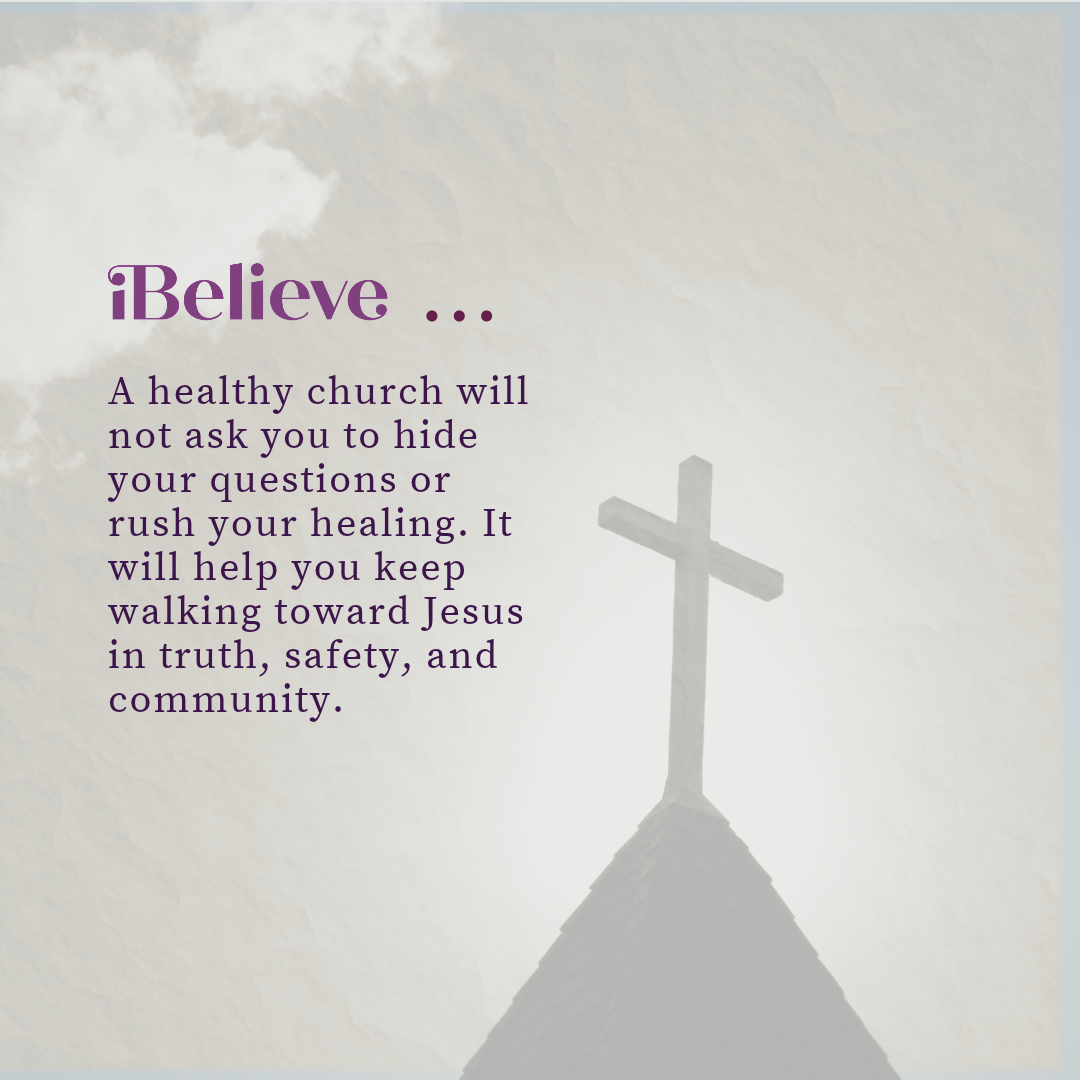
A healthy church centers its life on Jesus and Scripture while demonstrating humility, accountability, safety, and genuine care in its leadership and community. Consider whether the church:
- Clearly teaches the gospel and essential Christian beliefs.
- Handles Scripture faithfully and in context.
- Has qualified leaders who welcome appropriate accountability.
- Maintains clear safeguards for children and vulnerable people.
- Responds to concerns without intimidation, retaliation, or secrecy.
- Demonstrates financial transparency and responsible stewardship.
- Makes room for questions, discipleship, service, and relationships.
- Practices repentance, reconciliation, and the fruit of the Spirit.
Programs, music, location, and ministry opportunities can matter, but they should remain secondary to biblical teaching, trustworthy leadership, safety, and spiritual health.
Let Scripture Guide Your Search for a Church Home
Use this Bible-study printable to examine what Scripture says about Christian teaching, leadership, fellowship, accountability, and spiritual growth as you evaluate a potential church home. Download the W.O.R.D. Method of Scripture Study printable and begin studying the biblical qualities of a healthy church community.
Frequently Asked Questions about Finding a Church Home
- How do I know whether a church is healthy?
A healthy church teaches Scripture faithfully, centers its message on Jesus, holds leaders accountable, protects vulnerable people, handles conflict honestly, and helps believers grow through worship, discipleship, service, and community. No congregation will be perfect, but healthy churches respond to mistakes with humility and repentance. - How many churches should I visit before choosing one?
There is no required number. Attend long enough to observe more than a single worship service. Read the church’s statement of faith, listen to several sermons, ask about leadership and safeguarding policies, and speak with people who are involved in the congregation. - Is it okay to leave an unhealthy church and find another one?
Yes. Remaining committed to Christian community does not require remaining in a church marked by abuse, manipulation, serious doctrinal distortion, secrecy, or persistent refusal to address wrongdoing. Leaving one congregation is not the same as abandoning Jesus or the worldwide Church. - How can I trust a church again after being hurt?
Trust can be rebuilt gradually. Give yourself permission to ask questions, maintain appropriate boundaries, observe how leaders respond to concerns, and involve a trusted friend, counselor, or mature Christian in the process. You do not need to offer immediate trust simply because a church calls itself Christian.
For Further Reading
- 4 Steps to Finding a Great Church Home
- 8 Helpful Questions You Should Ask Before Joining a Church
- 7 Marks of a Church You Can Trust
- How to Trust God Again After Church Hurt
- 10 Sure Signs You're in a Healthy Church
Photo Credit: ©iStock/Getty Images Plus/FluxFactory


