
To follow God well, we must know him well. He’s revealed himself through his word, both the person of Jesus and the Scriptures. But studying the Scriptures is not always as straightforward as we may think. What we call the Bible is a collection of 66 books written thousands of years ago by over 40 authors. It contains multiple genres, such as poetry, narrative, prophecy, letters, and more. BibleProject’s How to Read the Bible series explains how narrative, poetry, prophecy, letters, and other biblical genres communicate in distinct ways. Understanding Scripture, interpreting it accurately, and applying its theological truths to our lives today remain the challenges of every follower of Jesus.
Key Points
- Studying the Bible well requires understanding its historical, cultural, literary, and theological context before applying its truths to life today.
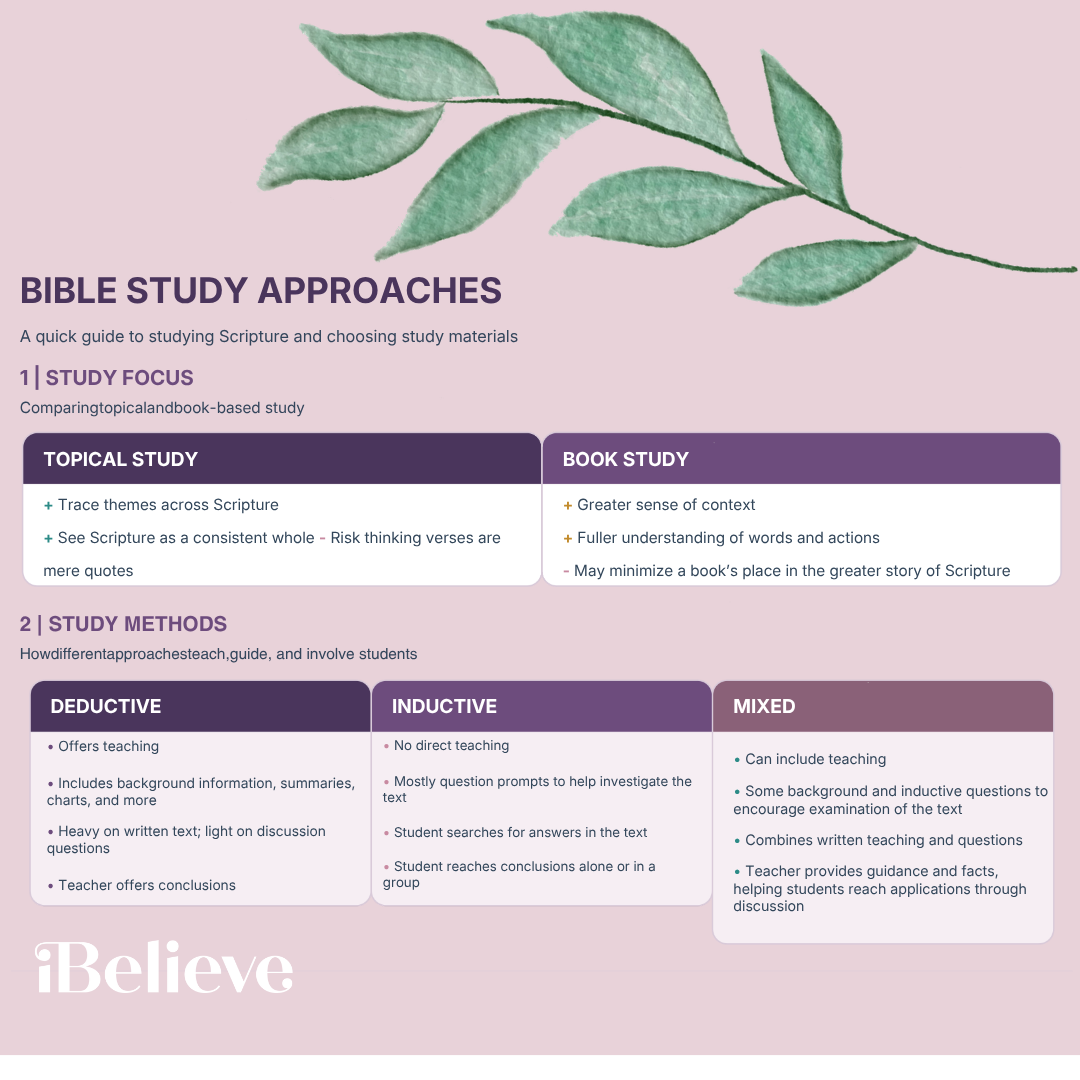
- Inductive studies emphasize observation, correlation, interpretation, and application, while deductive studies provide more instruction and explanation from the instructor.
- A mixed study method combines helpful background information with opportunities for readers to investigate Scripture and draw their own conclusions.
- Book-based studies provide deeper context within individual books of the Bible, while topical studies help readers trace themes and ideas across Scripture.
- When choosing a study Bible, consider the kind of support you need and look for resources shaped by multiple qualified contributors rather than a single theological perspective.
Our task as Bible readers is to grasp content that was written for us, but not to us. Learning the historical, cultural, and literary background of each part of the Bible is necessary to gain an accurate understanding of what those authors intended to communicate. Thankfully, we have many resources available to help us study our Bibles well. In fact, one could argue there are too many to choose from, complicating our journey toward biblical literacy. The best choice is not a single perfect resource; it is the method, workbook, or study Bible that best matches your current goal while keeping Scripture itself—not supplemental material—at the center. Understanding the differences between these resources can help you choose confidently without becoming overwhelmed by all the available options. So let’s talk about three broad categories related to our study of Scripture:
- Study Methods: inductive, deductive, or a combination?
- Study Workbooks: book-based or topical?
- Study Bibles: which version and what kinds of supplements?
What Bible Study Method Should I Use?
The right Bible study method depends on how much guidance you need, how much time you have, and whether your goal is discovery, instruction, or a combination of both. We can approach Scripture from one of three methods: inductive, deductive, or a mix of the two. We should not value one over the other, as each has its strength.
What Is the Inductive Bible Study Method?
Inductive Bible study begins with close observation of the biblical text and moves toward careful interpretation and personal application. Inductive studies ask us to investigate the text, to ask it questions and discover the information it holds. They are usually found in studies on books of the Bible. A well-established process looks like this:
- Observation:
Take note of the people, places, things, and actions in the passage. Know which genre you are reading. Act like an investigative reporter, using the “who, what, when, where, why, how” approach. Often this step involves researching background information to help make sense of certain words or topics. For instance, a study of the ten plagues God sent to Egypt should alert readers to the false gods the Egyptians worshipped. A quick research digression into those gods will show that God targeted those “gods” through each plague, demonstrating his superiority.
- Correlation:
Discern where this passage fits within the broader biblical and historical context. Are you in the Old or New Testament? What theological truths are evident in this passage? Where have you seen key words before? Make connections between the verses you are studying and other parts of the Bible.
- Interpretation:
Ask “what did the original author mean?” This step often entails knowing cultural norms and historical background. Then draw out a general theological conclusion. For instance, in Isaiah 5, the prophet warns Israel of the judgment God is bringing because of their ungodly behavior. The theological principle true for everyone is that God hates (and judges) injustice and idolatry. Rather than attempt to make the interpretation fit us, we look for the broad truth revealed.
- Application: Only now that we have observed and correlated the content of the passage, then interpreted it in light of its original context, can we apply it to our 21st-century lives. What would God have us do now?
Examples of Inductive Bible Studies
The Kay Arthur Precepts line of inductive studies has been a beloved resource for years. The Discover Together Bible Study series by Dr. Sue Edwards (Kregel) offers a more up-to-date inductive style, covering a dozen or more books of the Bible. Both sets of studies offer a robust inductive approach that can be worked on individually and in groups.
What Is the Deductive Bible Study Method?
Deductive Bible study relies more heavily on a teacher or author who presents background information, conclusions, and possible applications for the student to consider. The deductive method of Bible study allows the teacher or writer to do most of the investigative work for you. Both topical and Bible-book studies can be approached through a deductive model. These studies offer a larger proportion of teaching content, often through a streaming video option in which the author teaches each lesson. These video studies can help smaller churches equip their women with vetted, experienced teaching.
You’ll see sections in a deductive study that offer word studies explaining key terms, background information relevant to the passage, and one or more interpretations to consider. The student’s work is to absorb the teaching and consider how the suggested applications might fit best.
Examples of Deductive Bible Studies
Lifeway Resources regularly produces studies taught and written by dynamic Bible teachers. Authors like Priscilla Shirer, Kelly Minter, Kristi McClelland, Jennifer Rothschild, and more have created workbooks and teaching videos that churches and individuals can use for a full-
When Is a Mixed-Bible-Study Approach Best?
A mixed approach combines independent investigation with trustworthy teaching and often works well for beginners and groups with different levels of biblical knowledge. Often, studies offering a mixture hit the sweet spot: They include history, language, and cultural background teaching that establish helpful context, but they also require the student to dig into Scripture for themselves. Teaching videos may or may not be included. These mixed-approach topical and whole-Bible book studies suit a broad range of students, including those who are new to the faith or the Bible, as well as those without access to background information.
Examples of Mixed-Method Bible Studies
Consider Dr. Sandra Richter’s studies in her Epic of Eden series (Harper Christian), in which she offers seminary-level background in history, geography, and Hebrew. Students emerge with a deeper understanding of how Old Testament culture worked, knowing key terms more fully, and integrating the Old with the New Testament.
Dr. Sandra Glahn’s Coffee Cup Bible Study series (Abingdon Press) also offers a mix of teaching and questioning, organized into weekly topics with daily work. She also adds devotional material for weekend reflection.
Should I Choose a Book-Based or Topical Bible Study?
Choose a book-based study when you want sustained context, and choose a topical study when you want to trace a subject across multiple biblical passages. Another question Bible students ask is whether to learn through a book-of-the-Bible approach or through topical study. Instead of asking which is better, we should approach our choice with our goal in mind. Both have value, but they meet different needs.
What Are the Benefits of a Book-Based Bible Study?
Book-based studies help readers follow an author’s argument, historical setting, themes, and literary structure in context. Studying the books of the Bible grows our understanding of Scripture as a whole, helping develop our sense of its historical and theological trajectories. We learn about stories, characters, settings, and events in their biblical contexts, and we are better equipped to understand the purpose and themes of each book. The downside: often we can miss themes that thread through the entire Bible.
What Are the Benefits and Risks of a Topical Bible Study?
Topical studies reveal themes that run across Scripture, but they require careful attention to context so that individual verses do not become isolated quotations. Topical studies can help us see broader themes and connections across Scripture. Some studies trace concepts like peace, suffering, temptation, work, and many others, hopping across books to explore different passages that discuss them. Other studies choose an item or location, such as sticks, mountains, water, or stones, to illustrate metaphors and imagery that communicate truths about God. The downside: too many topical studies, and we risk seeing the Bible as a collection of quotes.
As we establish our group's needs, we will be better able to determine which type of study will best serve them.
How Do I Choose the Right Study Bible?
Choose a study Bible by evaluating its translation, contributors, theological perspective, intended audience, and the kinds of notes and features that support your study goals. Before we can choose the right Study Bible for our habitual time in Scripture, we need to determine what kind of help we require. Alongside the text of Scripture, study Bibles add supplemental material to encourage deeper understanding. For instance, in the book of Genesis, one might find maps, word studies, family trees that explain relationships among important people, or short essays that elaborate on concepts introduced in that section of the book. These sidebars, charts, and illustrations add context and background intended to expand today’s readers’ understanding of the ancient text.
Any study Bible with contributions from only one person will skew toward that person’s theology. While they may be respected scholars, the content they offer remains limited to their viewpoint. Look for study Bibles with a variety of contributions that come from a group of scholars.
The NLT (New Living Translation) Every Woman’s Bible offers supplemental material written solely by female biblical scholars and theologians. The text places special emphasis on women and on topics that impact women today. This Bible also integrates with the free Filament app, which uses a mobile device to enhance the added resources with even more study and devotional content.
The CSB (Christian Standard Bible) Women’s Study Bible also boasts content contributed exclusively by women—over 50 female scholars wrote short essays, historical background sidebars, and contextual content to supplement the text. Added resources also include short biographies of women in church history, charts and tables, illustrations, word studies, and devotionals.
Which Bible Study Resource Should You Choose?
Start with your purpose rather than the most popular product. If you want to develop close-reading skills, try an inductive method. If you need more instruction, choose a deductive study. If you want both guidance and personal discovery, begin with a mixed approach. Then select a workbook and study Bible whose translation, contributors, theology, and features support that goal—always allowing Scripture itself to remain the final authority.
Put Your Bible Study Routine into Practice
Use this 90-day Scripture-writing guide to slow down, observe the biblical text carefully, reflect on its meaning, and build a consistent habit of engaging God’s Word.
Download the Fall 2026 Scripture Writing Challenge and begin practicing one simple, repeatable way to study Scripture today.
Frequently Asked Questions about Bible Study Methods and Study Bibles
- What is the best Bible study method for beginners?
A mixed approach is often helpful for beginners because it provides foundational instruction while still encouraging readers to examine Scripture for themselves. The best method is one that helps you understand the text in context and practice studying consistently. - Is inductive Bible study better than deductive Bible study?
Neither method is automatically better. Inductive study develops close-reading and interpretive skills, while deductive study provides more direct guidance from an experienced teacher. Your goals and current biblical knowledge should guide your choice. - Should I study an entire Bible book or begin with a topic?
Begin with a book-based study when you want to understand context, structure, and the author’s message. Choose a topical study when you want to trace a biblical theme, but examine every cited verse within its original context. - What is the difference between a regular Bible and a study Bible?
A study Bible contains the biblical text plus supplemental material such as introductions, maps, timelines, articles, cross-references, and explanatory notes. Those additions can be helpful, but they are not part of the inspired biblical text. - Are study Bible notes always correct?
No. Study notes reflect the interpretations and theological framework of their contributors and editors. Readers should compare the notes with Scripture, examine the context, and consult other reliable resources when necessary. - Should I use more than one Bible translation?
Comparing translations can help you notice wording differences and understand difficult passages. It is still helpful to choose one reliable translation as your primary reading Bible so that your regular study remains consistent.
For Further Reading
- How to Study the Bible for Beginners
- What Is a Study Bible and How Do I Use It?
- 7 Steps to a Deeper Understanding of the Bible
- 10 Tips for Studying Your Bible
- What Are the Most Effective Tools for Finding the Best Bible Translation?
Photo Credit: ©GettyImages/Paul Giglia


