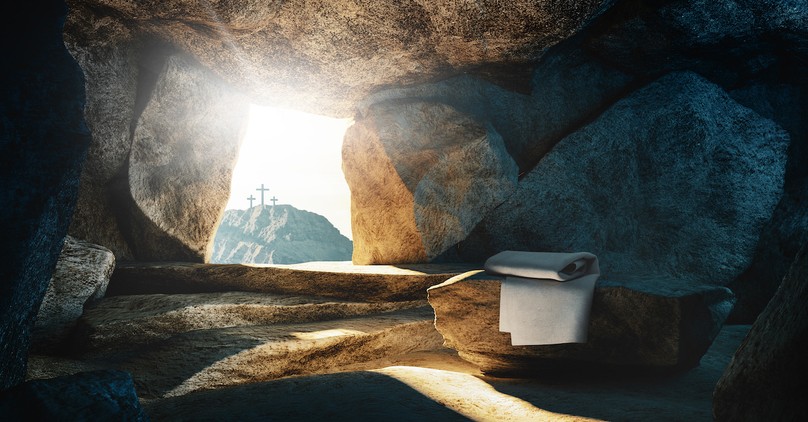
It’s a Monday morning, but transparently, this new week brings a lot of anxiety. I’m steps away from a book deal with a Big 5 Publisher, and it seems too good to be true. Like the rug will be pulled out from me at any moment if I mess up or don’t measure up, and it can. I could become traditionally published or not. The tension of waiting in the space between is nearly deafening.
It’s also Holy Week; the time leading up to Jesus’ death and Resurrection, when dead things come alive, and miracles happen. And I’m reminded that, though Jesus’ story is miraculous and beautiful, it was also scary, dark, and unknown to those living it at the time—people who were waiting for answers too.
Like Jesus' Disciples, many of us have experienced the power of the living and breathing Messiah. We’ve seen Him radically transform our lives. But we’ve also experienced times of great sorrow, loss, and confusion. Even the Gospel itself can seem confusing: What kind of God sacrifices His own son’s life for the sins of the whole world? It’s a love we can barely comprehend. The question is, what do we do with this tension?
If we’re honest, most of us love the breakthrough of the Gospel story, but we hate the silence. Everyone celebrates Sunday, but what about Saturday? What if Easter isn’t just about the resurrection, but the painful, confusing wait in between?
Easter Is All About Waiting (And We Skip That Part)
In the 21st century, we live in a culture obsessed with fast answers, instant clarity, and immediate service. Waiting feels foreign, unfamiliar, and uncomfortable when stop lights longer than a minute test our patience, and waiting in the grocery store line gives us an excuse to scroll on our phones. Even on social media, waiting isn’t a part of it. We can click, peruse, and watch as many reels as we want. Not only that, but faith spaces show all the times God showed up, and rarely talk about when He doesn’t. Stories show the miracles and healing, but not the hurting and helpless. But the reality is that Jesus and His Disciples didn’t experience an Easter like this in real time. No, they lived in the in-between. The sacred, scary, holy, and confusing space of what they knew to be true, but also what their eyes had seen.
When it comes to the Gospel story, we love the resurrection, but we avoid the waiting. And why wouldn’t we, right? Without the Resurrection, you and I are still dead and enslaved to sin. It’s an incredible story. But when we forget the crucifixion, the death, the pain of waiting, we miss a greater part of the story because Good Friday was a loss. The loss of the greatest man to ever walk the earth. He was sinless, perfect, fully human, and fully God. As John 1:29 quoted Him, “the Lamb of God who takes away the sin of the world!” (NLT).
This time was incredibly dark and bleak. Everyone struggled to understand. They even began to doubt as fear and confusion swept their minds. If Jesus was really who He said He was, how could this be the end? They’d all seen too much: His miracles, His power, His holiness, for this to be the end. And so, they waited in the silence.
Yes, we know Sunday would be the victory, but they didn’t. They hoped, and they believed, but they also saw Jesus’ body on that cross. His mutilated body, torn to shreds. We often skip from Friday to Sunday, but on Saturday, it was silent. Confusion, disappointment, and grief flooded the room. They even began to question everything Jesus said. Because for them, they hadn’t yet met the resolution. And sometimes, days like Saturday are when it feels the hardest.
What Holy Saturday Teaches Us About Waiting on God
Instead of glimpsing past the waiting, I encourage you to sit in the discomfort of Holy Saturday and what it teaches us about whatever season we find ourselves in. Some of you are waiting on test results or guidance. Miracles and healing that never seem to come. Answers to prayers you’ve been praying for decades. Maybe you’ve even received bad news when you thought it would finally be good. No matter the circumstance, press into these 4 truths:
1. God Can Be Working Even When It Feels Quiet
When Jesus died on the cross for our sins, He was doing something (defeating death). To the human eye, however, the giving up of His Spirit appeared as a failure. But as the Maverick City Song The Story I’ll Tell writes, “The hour is dark, and it's hard to see, what You are doing' here in the ruins, and where this will lead. Oh, but I know that down through the years, I'll look on this moment, and see Your hand on it, and know You were here.” Even in our own lives, God is still working, even amidst unseen moments. God can still be working, even when it feels quiet.
2. Waiting Doesn’t Mean You Did Something Wrong
As the Disciples saw Jesus die on that cross, you have to wonder if they felt like they had done something wrong. Was this really the end? Were they being punished for their sins? The questions they faced are surely innumerable.
Jesus was punished for our sins because that was the story God had for Him. But it was His love that held Him to that cross. He wasn’t punishing the Disciples; they were merely understanding their part in the story. Sometimes the best things in life come as a result of delay, even if it doesn’t feel like it in the present moment. Delays are a normal part of life, whether we wish to accept that fact or not. And more often than not, He’s building something foundational in that waiting.
3. Faith isn’t proven in the Breakthrough; It's formed in the Waiting
Thankfully for our story and the Disciples, Jesus’ death on the cross wasn’t the end. But anyone can believe when the miracle comes. Blessed are those who trust even when the waiting drags on. Because faith isn’t proven in the breakthrough, rather it’s formed in us in the waiting. And that waiting builds immense trust.
4. The Story Isn’t Over Just Because It’s Unclear
Looking back over the Easter story, Saturday felt like the end. The curtain in the Temple had been torn, and the King of the world was dead. But just because something looks a certain way doesn’t mean that’s how things really are. Saturday appeared as the final straw. The dead-end of the road. But it wasn't. As Jesus told Peter in Matthew 16:23b, “You are seeing things merely from a human point of view, not from God’s.” (NLT).
Just because something is unclear or unknown doesn’t mean the story isn’t over. It means that we need to develop a higher POV, one beyond ourselves and what the human eye can see or the mind can fully comprehend.
What It Looks Like to Trust God While You Wait
This Easter, I don’t know that waiting season you’re walking through, but I know that it’s possible to trust God while you wait. Stay connected to the vine (God) through Scripture, prayer, and community, and be honest with the Lord about your emotions. Sit in the discomfort and ask Him to help you not rush the process.
I don’t think any of us truly like waiting. I certainly know I don’t. But even in my own season, I’m learning to trust the process. I don’t know what my future holds, traditional book deal or not, but I trust His purpose and timing for me.
If you find yourself in a silent Saturday season right now, you’re not alone. Unanswered prayers and uncertainty are incredibly difficult to navigate. But God is not absent in the silence. He wasn’t when He died on the cross, and we were waiting for His resurrection, and He isn’t now. And the waiting you and I endure is never wasted. It’s part of the resurrection stories. Sunday is coming, but Saturday still matters.
“Joseph took the body, wrapped it in a clean linen cloth, and placed it in his own new tomb that he had cut out of the rock. He rolled a large stone in front of the tomb's entrance and left. Mary Magdalene and the other Mary were sitting there opposite the tomb. The next day, the one after Preparation Day, the chief priests and the Pharisees went to Pilate. “Sir,” they said, “we remember that while he was still alive, that deceiver said, ‘After three days I will rise again.’ So give the order to make the tomb secure until the third day. Otherwise, his disciples may come and steal the body and tell the people that he has been raised from the dead. This last deception will be worse than the first.” “Take a guard,” Pilate answered.
“Go, make the tomb as secure as you know how.” So they went and made the tomb secure by putting a seal on the stone and posting the guard” (Matthew 27: 59-66, NIV).
Photo credit: ©GettyImages/alessandrophoto


