
The words coming out of the person’s mouth were intended to be encouraging, but they weren’t. Instantly, I wondered, “Is that really in the Bible?” Although the saying sounded similar to verses I’d heard before, the wording seemed off. At the time, I wasn’t well-versed in Scripture and was unsure how to determine whether the words were grounded in truth.
I smiled and offered a polite response, but the moment lit a fire in me to explore God’s Word. I realized I didn’t want my roots to be shallow. When life's storms hit, I wanted to know what was true rather than simply relying on others' interpretations. Many familiar Christian sayings sound biblical without appearing anywhere in Scripture, while others alter or remove the original passage’s context.
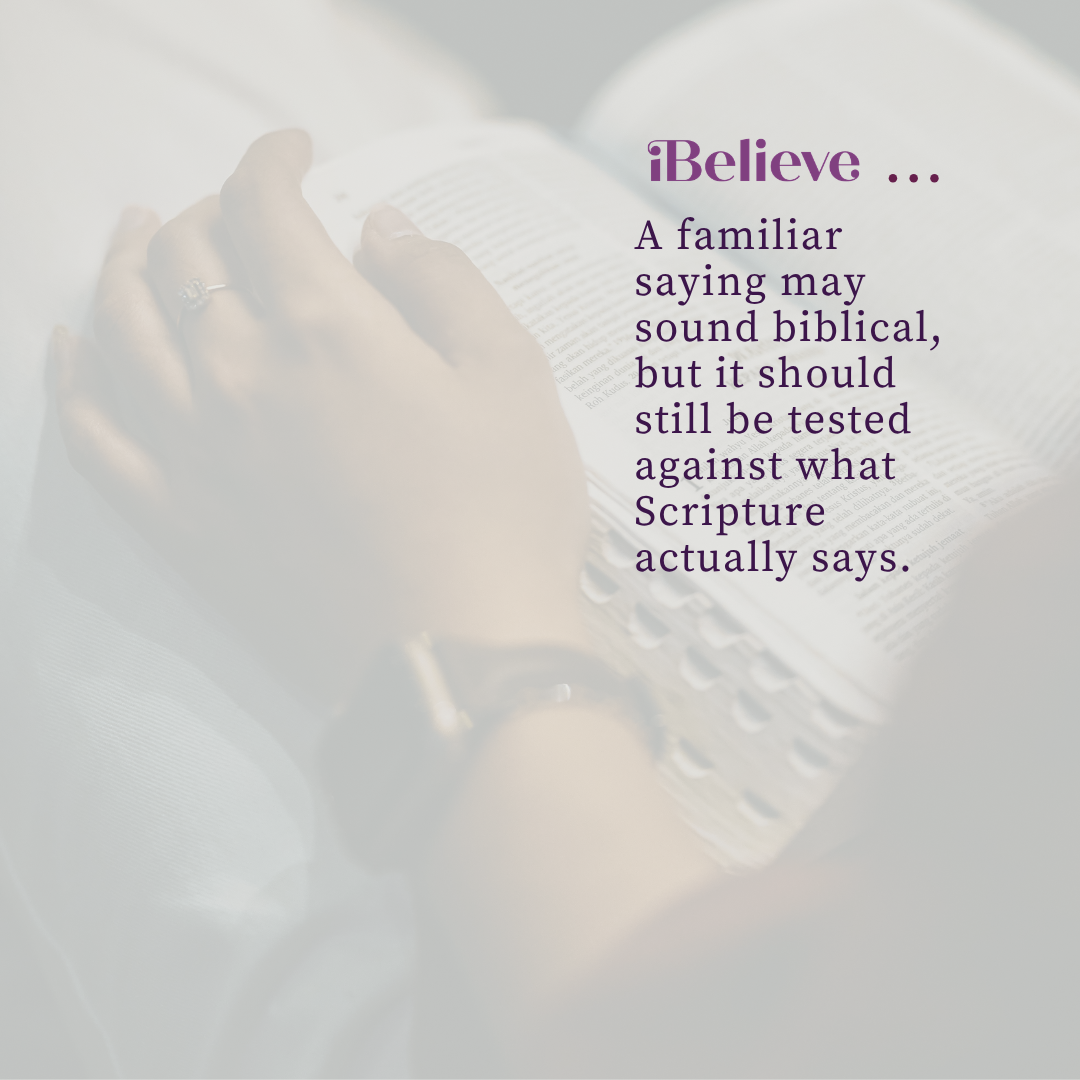
The good news is that when we seek God and ask for His wisdom, He is faithful and will not let His Word return void. Here are ten common sayings that are not in the Bible as written, or are frequently misquoted or taken out of context. Some reflect a biblical idea, but each one should be tested against what Scripture actually says.
Key Points
- Many familiar Christian sayings sound biblical but are either not in Scripture, misquoted, or taken out of context.
- Sayings like “God won’t give you more than you can handle” can unintentionally shift the focus from God’s strength to our own ability.
- Comforting others well means offering biblical truth with compassion rather than relying on phrases that may add confusion or pain.
- Several popular sayings come from real verses, but the meaning changes when key words, context, or the larger biblical message are ignored.
- Knowing Scripture helps believers discern what is true, wisely encourage others, and point people back to God’s Word rather than cultural clichés.
Photo Credit: ©Unsplash/Mimi Thian

1. Does the Bible Say God Won’t Give You More Than You Can Handle?
If you’ve spent significant time in Christian circles, you’ve probably heard this adage. Usually, the person means well, but the saying can be dangerous in its implications. It might sound as though God is sitting up on His throne, handing out suffering and trials in a callous way, expecting us to bear the weight of it on our own. The words also put the focus on us, and our abilities, rather than on God, who is our Healer and Advocate.
This saying is likely based on a couple of different verses in the Bible, with one source being 1 Corinthians 10:13: “No temptation has overtaken you except what is common to mankind. And God is faithful; he will not let you be tempted beyond what you can bear. But when you are tempted, he will also provide a way out so that you can endure it.” As you can see, the last words point us back to God. It is God who will provide the way for us to withstand temptation, not ourselves.
The fact is, we can’t handle life on our own. We need God every moment of every day. Let’s not water down scripture with sayings that may lead others to believe they have to carry the hard stuff alone. Let’s ask ourselves, “What verses are actually in scripture that may be helpful to this situation?”
Photo Credit:Unsplash/Aaron Burden

2. Do People Become Angels When They Die?
Grief can bring out a whole other level of awkwardness in us. Especially when someone else is experiencing it, and we’re trying to be supportive. We want to help ease their burden, so we say things we’ve heard others say hundreds of times before. This saying falls into that category. It sounds good, but it’s not supported by the Bible.
If we look at scripture, it makes no reference to humans turning into angels. Angels and humans are two very distinct beings, created by God for different purposes. Scripture portrays heavenly beings praising God when He laid the earth’s foundations, and they are tasked with various responsibilities, including helping those in need. In Jesus’ darkest hour, God sent an angel to attend to Him: “An angel from heaven appeared to him and strengthened him” (Luke 22:43 NIV).
When we see references to deceased humans in the Bible, they’re referred to as “saints,” not angels. While God gives us responsibilities in the afterlife, they are distinct from those of angels.
Instead of making claims that aren’t in the Bible, let’s encourage our loved ones with truth. And the truth is that God is with them in their grief. Let’s ask ourselves, “How can I be present as they walk through this?”
Photo Credit: ©GettyImages/cranach

3. Does the Bible Tell Us to Speak Things into Existence?
This saying is popular with both non-believers and Christians. It can have many different connotations, but typically implies that if we want something and declare it, it will happen. Although God rewards faith in the midst of impossible circumstances, we need to be cautious of sayings that make humans out to be gods.
In Proverbs, it says, “The tongue has the power of life and death, and those who love it will eat its fruit” (Proverbs 18:21 NIV). So yes, our words do have power. However, we need to understand that any power we have comes from God. Yes, our words have remarkable influence, but only God can speak things into existence. It is only by His Word that the entire universe was created and boundaries were set.
These words from King Solomon are intended to be a warning about how to use our words. With only a few sentences, we can change the trajectory of someone’s life by either pointing to God’s power to work in them or speaking fear and doubt. The choice is ours. Let’s be mindful of the words we speak this week and ask ourselves, “How can I encourage someone who needs to know God is working?”
Related: Is It Biblical to Submit to Corrupt or Pagan Governments?
Today we dive into a topic that's often met with resistance: submission to government authorities. This concept is repeated throughout Scripture, from Romans 13 to 1 Peter 2, and even Jesus himself taught on this subject. But why should we submit to those in power, especially when we disagree or our government is corrupt? If this podcast helped you understand the Bible in a clearer way, be sure to follow The Bible Explained on Apple or Spotify so you never miss an episode!
Photo Credit: Yuri Manei from Pexels via Canva Pro

4. Does the Bible Say Everything Happens for a Reason?
This saying is usually offered as a way of comfort when something tragic, disappointing, or unexpected happens. It may give us a sense of order in the midst of chaos or comfort when we’re grieving. God is sovereign, so everything happens for a reason, right?
However, these words are not found in Scripture and may not be comforting at all. Especially when it’s used in the middle of unthinkable circumstances of evil and suffering. When we use this saying in these situations and others, it comes across as apathetic.
Is God intimately involved in the lives of those who believe? Absolutely. Paul tells us in Romans 8:28, “And we know that in all things God works for the good of those who love him, who have been called according to his purpose” (NIV). This saying may be inspired by the above verse. However, the verse says God works in all things, not that all things are from God. In other words, God can redeem what’s broken. But when someone hurts another human being, it is not God who is leading them.
Let’s remember to keep God in His rightful place, and humans in theirs. When something unexpected happens, let’s ask ourselves, “How can I point to what God is doing in this situation?”
Photo Credit:©Unsplash/Jelleke Vanooteghem

5. Does the Bible Say God Helps Those Who Help Themselves?
It’s true that God doesn’t reward laziness. Several proverbs warn us against lazy behavior, like this verse in Proverbs 19: “Laziness induces deep sleep,
and a lazy person will go hungry” (Proverbs 19:15 CSB). Throughout scripture, God honors those who use their resources, gifts, and abilities wisely. However, Scripture does not contain this direct quote.
Not only that, but there are times when people can’t help themselves. Whether it’s because of a physical illness, a financial hardship, or an unexpected tragedy, followers of Jesus endure seasons where they need to depend on others.
God does not call us to live a life of self-sufficiency, but of reliance on Him. In the gospel of John, He doesn’t say to help ourselves, but to abide in Him: “I am the vine; you are the branches. If you remain in me and I in you, you will bear much fruit; apart from me you can do nothing” (John 15:5 NIV).
As we go about our days, let’s remember to not only use what God has given us for His glory but also to seek His guidance in each step. Let’s ask ourselves, “How can I invite God into the big moments and the small ones this week?”
Photo Credit: ©Unsplash/Jmuniz

6. Does a Lack of Faith Prevent Someone from Being Healed?
When we throw sayings like this around, we only add another layer of hurt to a soul who is already suffering. In addition to whatever they’re going through, we make them think their spiritual life is weak. Friends, let’s not paint a picture of a God who is removed from our suffering. Jesus not only knows our suffering, but He enters into it with us.
The mindset of illness being associated with sin or punishment is not new. Jesus’ disciples associated physical ailments with sin as well. In John 9, when they saw a man born blind, they asked, “Rabbi, who sinned, this man or his parents, that he was born blind?” (John 9:2 NIV). Jesus corrects their limited thinking by responding, “Neither this man nor his parents sinned, but this happened so that the works of God might be displayed in him” (John 9:3 NIV).
While our suffering is the result of sin entering the world in the garden, Jesus points out an important distinction. Our pain gives a unique opportunity for God to display His power. And if God took all hardship away, there would be little opportunity for reliance on Him.
When someone is walking through a season of sickness or difficulty, let’s show the same compassion Jesus showed to others. Let’s ask ourselves, “How can I encourage someone who is still waiting for healing?”
Photo Credit: ©Pexels/Andrea Piacquadio

7. Is Cleanliness Next to Godliness in the Bible?
I love a clean home. When the dishes are done and things are put away, I can feel the tension loosen from my shoulders. And while it might be tempting for me to say that my affection for a clean home is because I’m so “godly,” I know better. It has more to do with my unique personality.
While it’s good to respect the gifts God has given us, we oversimplify His character when we say things like this. For someone who’s in the thick of motherhood, the above statement might feel like a slap in the face. Yes, God can be glorified when we clean our home, but what He cares most about is the souls being raised in the home. As Psalm 127 reminds us:
“Children are a heritage from the Lord, offspring a reward from him. Like arrows in the hands of a warrior are children born in one’s youth.” - Psalm 127:3-4 NIV
Let’s not forget that while God may honor a well-kept home, the most important thing is to care for the people in it. Let’s ask ourselves, “What important work does God have for me today?”
Photo Credit: ©GettyImages/Nattakorn Maneerat

8. Does the Bible Say Money Is the Root of All Evil?
This saying is almost a quote of scripture, but a couple of key words are left out. Namely, love. 1 Timothy 6:10 reads, “For the love of money is a root of all kinds of evil. Some people, eager for money, have wandered from the faith and pierced themselves with many griefs” (NIV, emphasis added).
Money on its own is amoral. It’s how we use it that matters. We can use it only to fulfill our own selfish desires that will never satisfy us, or we can use it to help others. We can give to causes that matter, or we can store up treasures here on earth. (Matthew 6:19)
Next to politics, money is one of the most divisive topics there is, and the enemy uses it to stir up dissension and lead people into sin. But if we misquote the scripture as the above, we create a picture of money having some sort of power over us. Yes, we can make an idol out of money, but we can also use it for good. The choice is ours.
Instead of thinking that money itself is evil, let’s ask ourselves, “How can I use this resource for good?”
Photo Credit: JP Valery/Unsplash

9. What Does “I Can Do All Things through Christ” Mean?
This saying is indeed based on scripture and appears in Philippians 4:13, which says, “I can do all things through him who strengthens me” (ESV). The problem is that most of the time when we see this verse quoted, it’s taken out of context. When he writes, "This is the church at Philippi," he is in a Roman prison. And yet, he is still filled with a joy that can’t be taken from him.
In the surrounding verses, Paul talks about how he has learned to be content in all circumstances, whether he is well fed or hungry. When he says, “I can do all things,” he is referring to the secret of being content, and it’s a strength that can only come from the Lord.
Yes, God can empower us to do impossible things. He can perform miracles and give us abilities we don’t possess on our own. But when we give this verse meaning that isn’t there and use it for things like competitions, we may put more pressure on those who simply need to know that God is with them. Instead, let’s ask ourselves, “How can I empower someone to be content, even if things don’t go according to plan?”
Photo Credit: ©Thinkstock/chaunpis

10. Is “This Too Shall Pass” Found in the Bible?
When we go through seasons of suffering, it’s comforting to know it won’t last forever. This saying is often offered in those chapters of life. We’re weary or perhaps grieving, and we need some reassurance of the so-called “light at the end of the tunnel.” But what about the times when the season lasts for months or even years? This saying may not bring much comfort then.
If we look at scripture, we find hope that our suffering will come to an end. While it may not happen in this lifetime, God promises to wipe away all our tears and redeem what the enemy has stolen. (Revelation 21:4) Our pain has an end date, and even though we don’t know the exact time when Jesus will return, we’re warned to be watchful and alert, not falling into a state of complacency. (Mark 13:33)
When our loved ones are going through hardship, it’s natural to want to provide relief and reassurance. But let’s turn to the truth found in God’s word rather than familiar sayings which may or may not be true. Let’s ask ourselves, “What does Jesus have to say about this?”
God, thank you for the gift of being able to read your Living Word. Thank you for the life and comfort it brings in seasons of abundance and in seasons of suffering. May we not take this precious gift for granted, but know it, use it, and proclaim it. When we’re tempted to turn to familiar sayings that are not grounded in your truth, may we wield the sword of the Spirit instead. In Jesus’ Name, amen.
Frequently Asked Questions about Sayings That Are Not in the Bible
- What are some common sayings that are not in the Bible?
“God helps those who help themselves,” “cleanliness is next to godliness,” “God needed another angel,” and “this too shall pass” are not direct Bible quotations. - Why do people mistake popular sayings for Bible verses?
Some sayings resemble biblical principles, while others repeat shortened or altered versions of actual passages. Repetition can make a familiar phrase sound scriptural even when its wording or meaning differs from the Bible. - Is “God won’t give you more than you can handle” in the Bible?
No. 1 Corinthians 10:13 says God provides a way to endure temptation. It does not promise that every hardship will remain within the limits of our personal strength. - How can I tell whether a Christian saying is biblical?
Search for the phrase in a reliable Bible translation, read any related verse in its surrounding context, compare it with other passages, and consult trustworthy study resources when necessary.
For Further Reading
- 7 Phrases Christians Like to Say That Aren't True
- 5 Verses You Thought Were in the Bible… but Aren't
- 5 Bible Verses You Need to Stop Misquoting
- 10 Popular Statements that Are Theologically Unsound
- 5 of the Bible's Most Misunderstood Verses
Photo Credit: ©iStock/Getty Images Plus/Daniela Jovanovska-Hristovska
SHARE


Originally published Tuesday, 29 September 2026.