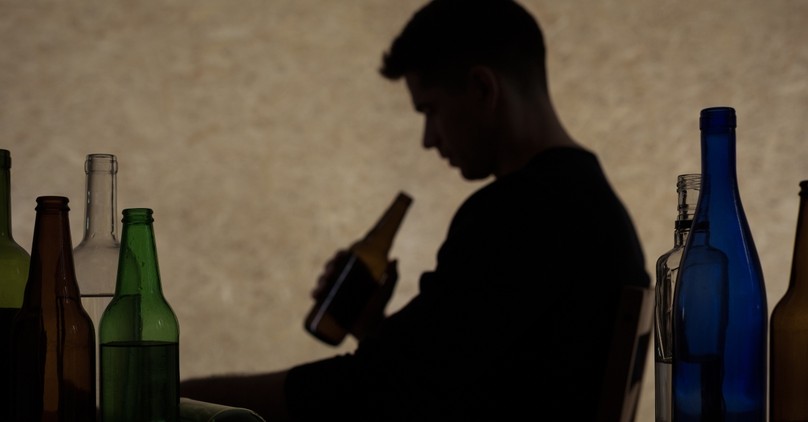
Early in my marriage to my Christian alcoholic spouse, I snuck a go-bag into the trunk of my car. Twenty years later, I reflected back on that time period with a friend who’d been married to an abusive man. She had also driven with a go-bag in her car. I looked at her and said, “Probably, if you know what a go-bag is, or you’re driving around with one …”
She finished my sentence, “It’s time to make a change.”
I’d been a “good, Christian girl,” and found myself married to an alcoholic before I understood alcoholism. I had no idea how to help my alcoholic spouse, and even though I thought I knew the biblical response to addiction in marriage, time and experience have wizened my perspective.
My husband was sober when I met him and passionately following Jesus. I thought that meant he’d overcome his addiction. I didn’t know addicts battle for sobriety daily. He relapsed the week before the wedding—a moment I revisit often—and the next two years were perforated by frequent relapses, darkness, loneliness, and shame. I feared telling friends or family because I didn’t want to receive judgment or admit failure.
Did I stay? Yes. Should I have? Probably not, except for one inescapable reality. Because of my experience, I was able to write this article and my late husband’s memoir.
How to Love Your Spouse without Enabling the Addiction
Indicators that you are enabling your spouse’s addiction:
- You’re not telling anyone who has the power to intervene.
- You’re pouring the drink down the drain yourself.
- You’re picking up the messes and repairing damages—discarding broken furniture, putting possessions flung back in their place, or patching holes in walls.
- You often need to remind yourself that the cruel words your spouse aims at you like darts are “the alcohol, not her (or him).”
- You know that your home scenario isn’t healthy, but you make no moves toward change.
Loving an alcoholic spouse requires firm boundaries and tough love. When my husband relapsed, I didn’t just keep his addiction a secret for his sake; I remained silent for selfish reasons too. People will know I made a mistake. I feel so duped. If I tell my family, they’ll never forgive him.
I rationalized circumstances every day. He’s not drunk all the time. He’s a Christian; God will deal with him.
Loving our spouse enough to get him or her the help they need is a pride-swallowing affair. In some cases, telling others could result in a dangerous backlash from the addicted spouse.
Should a Christian Stay with an Alcoholic Spouse?
Many Christians will tell you the only biblically acceptable reason to leave a spouse is in the case of adultery. I would argue that those Christians have never stood where you stood—and they certainly can’t see the cards you’re holding.
And there’s a vast difference between a functioning alcoholic and an abusive one. Spouses of alcoholics could also argue the difference between physical abuse and mental abuse.
Alcohol chemically alters a person. Therefore, the alcoholic spouse standing before you is not the same person you married. Should you stay? Unfortunately, you’re the only one who can answer that question.
When my late husband’s addiction was at its peak, and I was losing hope, I risked telling a Christian friend who’d been through the “hard.” Her words to me were beautiful, so now I am giving them back to you. She said, “When it’s time to divorce him, you’ll know.”
There was zero condemnation in her voice, zero judgment in her tone. “When it’s time to divorce him, you’ll know,” was a silent permission to leave if I needed to.
Your safety and well-being matter. The safety of your children matters. If loud, profane arguments are becoming more frequent and more venomous, it may be time to seek sanctuary. If objects are being flung across the room in anger, those outbursts will likely only become more dangerous with time.
Answering “when is it time to leave?” requires humility and introspection. Asking these questions and answering honestly means braving the reality you’ve been avoiding. Here are more hard, truth-revealing questions.
- How often are you making excuses for your spouse? How long ago did you start making these excuses?
- How many times have you been cussed at or hit? If your answer is laughter, it’s time to admit that your circumstances aren’t getting better.
- What were the concerns of others, the ones you didn’t want to hear? If they knew the full truth, what would they say?
- (Do not answer this question with a “Christian duty” or “the Bible says” response.) Why are you still in the relationship? Children, money, convenience, hope?
- How is your staying in the relationship, and in the home, enabling your spouse’s addiction? How is your silence enabling your spouse’s addiction? In what other ways are you enabling his or her behavior?
- Finish this sentence: “I would leave if …”
The Importance of Pastoral Care, Counseling, and Support
Counseling is crucial for the spouse of an addict. A trained counselor can mirror back a person’s thoughts and help a spouse navigate the best course of action. A professional will also recognize danger signs and help a spouse determine when it’s time to walk away from the marriage or suggest police intervention. Counselors are also great because they are unbiased, and conversations with them are confidential.
Many people suggest counseling for the addict himself. The problem with this idea is that counseling will only work if the alcoholic wants to change. And, even if an addict wants to be healthier or have a stronger marriage, the battle is an uphill climb. In addition, the motivation to change is often short-lived. Alcoholics are always alcoholics. They can’t have just one drink. They don’t have an off switch when it comes to this vice.
Biblical Boundaries for Being Married to an Alcoholic
There is a space between marriage and divorce. By staying in the home despite your spouse’s addiction, you are telling your spouse that he/she doesn’t have to change in order for you to stay.
I’ve advised many people in this situation to arrange a separation, which has multiple benefits. Separation…
- Shows the addict that you’re serious about wanting change.
- Provides an emotional breather and clarity.
- Gives you a chance to articulate what needs to happen in order for the relationship to work.
- Lends opportunity for counseling and rehabilitation.
- Reveals the alcoholic’s heart and desire to change. If your alcoholic spouse isn’t willing to work toward spiritual and physical health, you have your answer.
Conclusion
Following a two-month separation, my husband and I reconciled. By God’s strength, he remained sober for over nine years, when he succumbed to temptation. As a result of the relapse and subsequent drunk-driving accident, doctors found stage IV cancer in my 36-year-old husband’s body.
Jesus’s heart breaks over addiction, whether it is the addict or the family members affected. This life is only a dingy duplicate of what awaits us in heaven. Here, when life becomes unbearable, God’s word has the power to anchor our hearts with hope.
Bible Verses for Christians Married to an Alcoholic Spouse
“The LORD is close to the brokenhearted and saves those who are crushed in spirit” (Psalm 34:18).
He has sent me to bind up the brokenhearted,
to proclaim freedom for the captives
and release from darkness for the prisoners, ” (Isaiah 61:1).
“Blessed are those who mourn, for they will be comforted” (Matthew 5:4)
“Praise be to the God and Father of our Lord Jesus Christ, the Father of compassion and the God of all comfort, who comforts us in all our troubles, so that we can comfort those in any trouble with the comfort we ourselves receive from God” (2 Corinthians 1:3-4).
“Do not be anxious about anything, but in every situation, by prayer and petition, with thanksgiving, present your requests to God. And the peace of God, which transcends all understanding, will guard your hearts and your minds in Christ Jesus (Philippians 4:6-7).
Prayers for an Alcoholic Spouse
Dear Chain-breaker,
The shame of using launches _________ back into the addiction to numb the pain. The cycle is maddening for __________ whose desire to quit is greater than anything, except his/ her desire to use. The cycle is nearly impossible to escape. God, this is where you step in. You are the breaker of chains, defender of the weak. You are a strong fortress. You are the embodiment of victory. Please step into the fray and be _______’s champion.
From: Prayers Against Addiction: Praying for Your Addict Where the Needle Pierces Skin
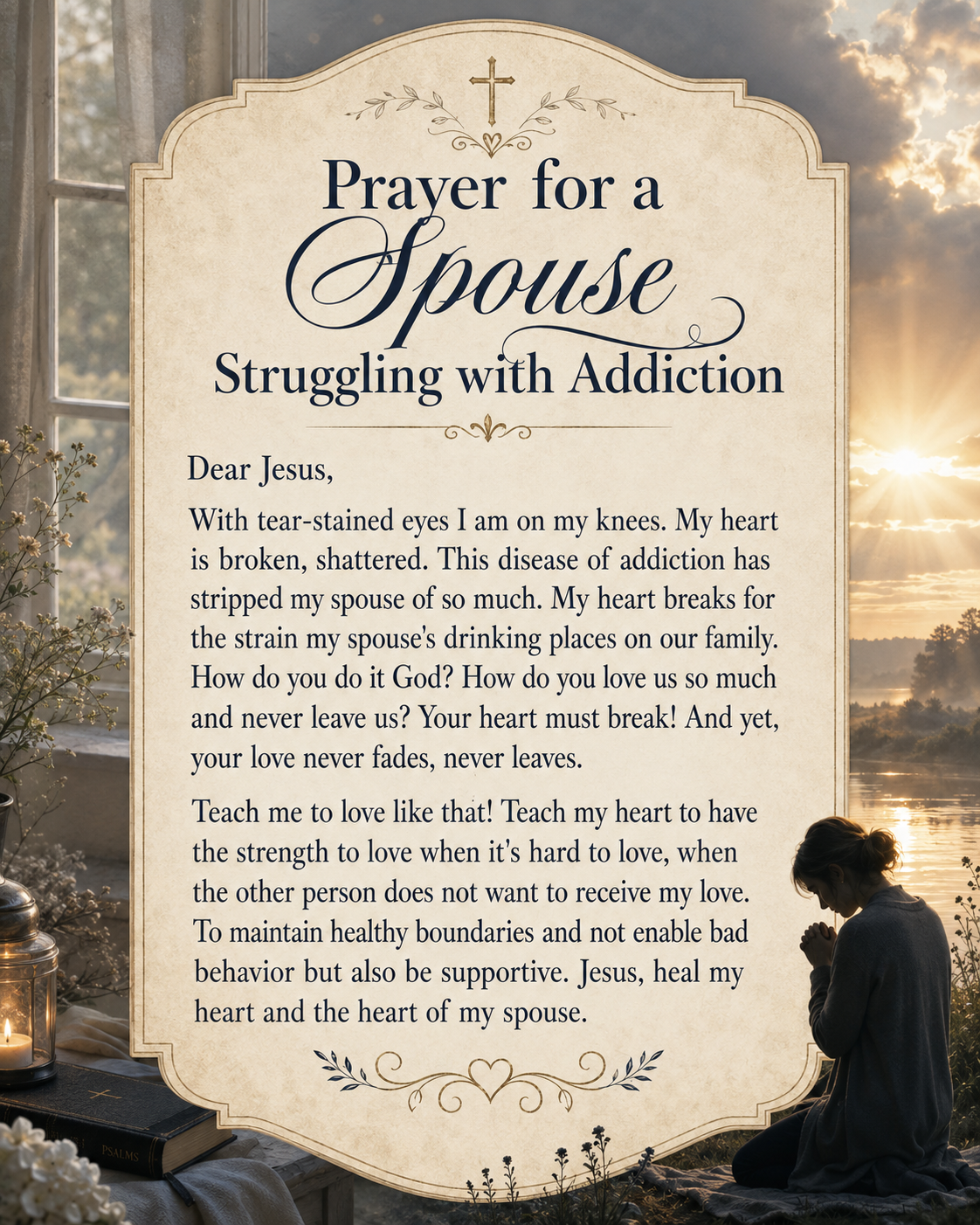
Dear Jesus,
With tear-stained eyes I am on my knees. My heart is broken, shattered. This disease of addiction has stripped ___________ of so much. My heart breaks for the strain _________’s drinking places on our family. How do you do it God? How do you love us so much and never leave us? Your heart must break! And yet, your love never fades, never leaves.
Teach me to love like that! Teach my heart to have the strength to love when it's hard to love, when the other person does not want to receive my love. To maintain healthy boundaries and not enable bad behavior but also be supportive. Jesus, heal my heart and the heart of ____________.
From: Prayers Against Addiction: Praying for Your Addict Where the Needle Pierces Skin
Dear God,
_________ cannot do this on his/her own. He/ She needs Your help and help from others. Please help ________ set pride down to receive help. I can’t imagine having to admit my faults so vulnerably, the way he’ll/ she’ll be forced to do. May people be receptive and tender-hearted as they listen. Please give _______ a safe place, a safe person to practice sharing his/ her story with. Please help others to be trustworthy with his/ her heart.
From: Prayers Against Addiction: Praying for Your Addict Where the Needle Pierces Skin
Dear God,
That argument was pretty bad. I’m so tired of _________’s needs and selfishness trumping mine. ________ steals my peace, my joy, my time, my energy, and my money. _______ exhausts me and I don’t know if I have what it takes to help ______ anymore. I’m so tired. Help me define the space between boundaries and grace. Tell me when it’s time for distance. Speak clearly, so I don’t mistake my own thoughts for Yours. Above all, please step into the damage we’ve done to one another and create space for reconciliation in the future.
From: Prayers Against Addiction: Praying for Your Addict Where the Needle Pierces Skin
Resources for Alcoholics and Their Families
If you are married to an alcoholic spouse, you do not have to carry this burden alone. Prayer matters deeply, but God often brings help through wise counselors, recovery groups, pastors, doctors, and trusted believers who can walk with you in truth and safety. Consider resources such as Alcoholics Anonymous, Al-Anon or other family support groups, a licensed Christian counselor, your church’s pastoral care team, and local crisis or domestic abuse services if your home is unsafe. Seeking help is not a failure of faith. It is a wise step toward honesty, healing, and protection for everyone involved.
Alcoholics Anonymous—Have a problem with alcohol? There is a solution.
Al-Anon—Al-Anon members are people, just like you, who are worried about someone with a drinking problem.
Celebrate Recovery—A safe place to find freedom from your hurts, hang-ups, and habits.
Photo credit: ©Getty Images/KatarzynaBialasiewicz

SHARE


