

The AI landscape is advancing rapidly. Just a few short years ago, people were just experimenting with ChatGPT, exploring what AI might become. Now AI is increasingly woven into search engines, social media, education, work, writing, digital creation, customer service, healthcare, and more. AI is seemingly everywhere now. It is already shaping what people see, read, hear, buy, create, and believe. This leads us to wonder:
How should Christians think about AI without either becoming dependent on technology or becoming consumed by fear of how it may change our world? Christians do not need to reject AI or embrace it without question. We can receive it as a tool while testing its claims, protecting human dignity and relationships, and refusing to let convenience replace truth, wisdom, creativity, or dependence on God. As our world continues to change rapidly, we need wisdom, discernment, humility, and commitment to truth. 2 Timothy 1:7 reminds us, “or the Spirit God gave us does not make us timid, but gives us power, love and self-discipline.”
Key Points
- AI is rapidly changing how people work, create, communicate, and consume information, making Christian wisdom and discernment increasingly important.
- Because AI can generate convincing but inaccurate content, believers should verify sources, investigate claims, and prioritize truth over convenience.
- AI can be a useful tool, but it should not replace human wisdom, creativity, relationships, spiritual guidance, or dependence on God.
- Christians should consider how AI affects jobs, creativity, young people, and human connection while continuing to value people over productivity.
- Technology will continue to change, but believers can respond without fear by using AI carefully, following Scripture above algorithms, and trusting God’s unchanging character.
What Is Artificial Intelligence?
Artificial intelligence refers to computer systems designed to perform complex tasks normally done by humans. This includes computer programs that can perceive, plan, reason, learn, communicate, make decisions, and act. Artificial intelligence was first created in the 1950s, and since then, the technology has continued to advance. In the 1980s, machines began learning from historical data. In the 2010s, machines began learning from models that mimic human brain function. Now, in the 2020s, Generative AI was invented. This AI can create original content.
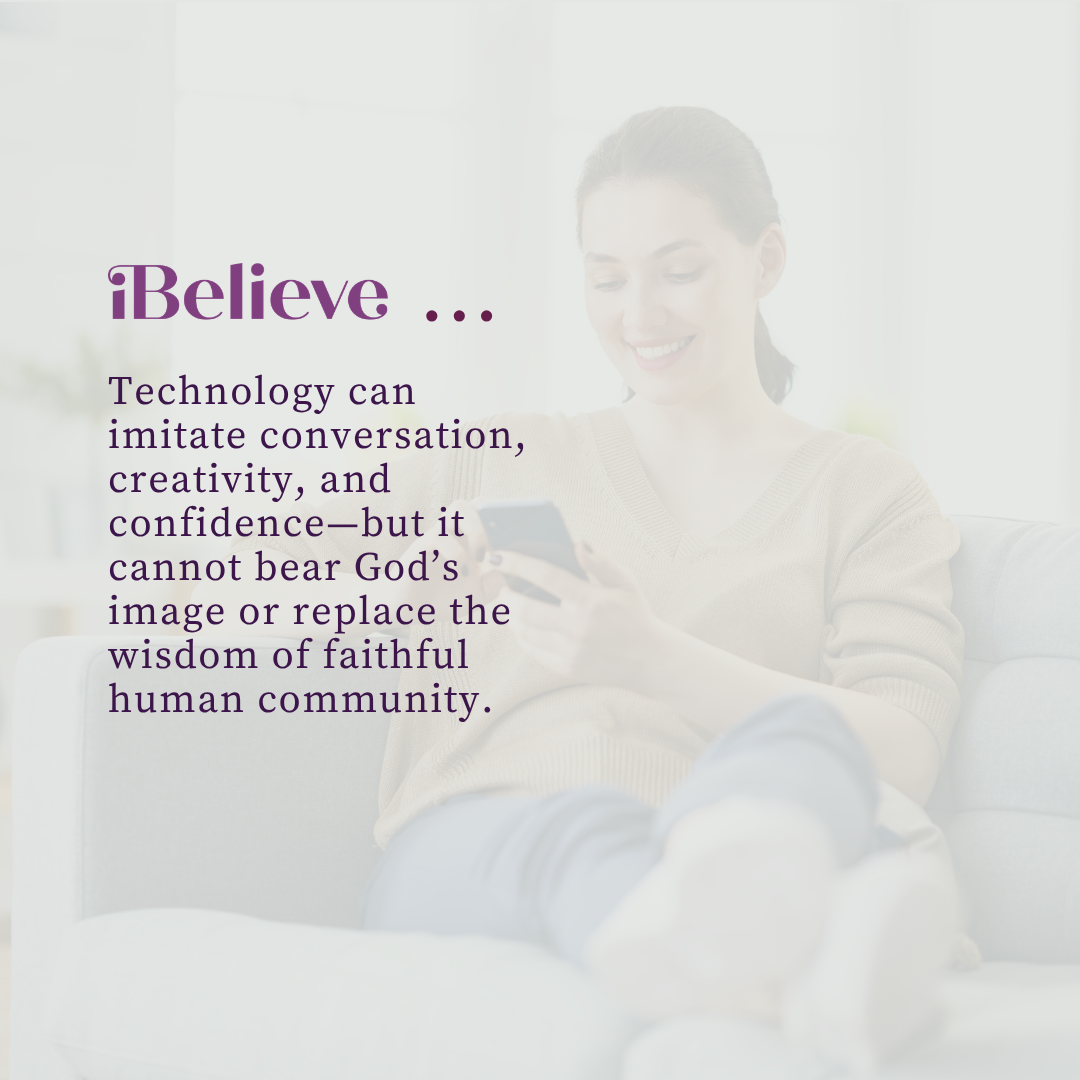
Generative AI can produce content that appears remarkably human-like. It does not possess human wisdom, a soul, or a biblical understanding of truth. Al can only imitate human communication but cannot become human. Genesis 1:27 teaches, “So God created mankind in his own image, in the image of God he created them; male and female he created them.” We alone are made in the image of God. We must be wise in how we utilize and interact with technology, keeping in mind that there are some needs technology can’t and should not meet for humans. Also, there are subjects on which technology should not be our source of wisdom, as it does not bear a soul.
Why Does AI Make Truth Harder to Discern?
AI can produce convincing content and images. Already, as we scroll through our social media feeds, we have to pause and consider whether what we are looking at is real or generated content. Another issue we see with AI is that it can produce completely inaccurate yet highly professional-looking findings. If we aren’t careful to double-check work created by AI, we can easily be led astray by inaccurate information.
What is alarming is that AI-generated images, videos, and even audio can fabricate events that appear authentic. Those with malicious intent can easily put words into other people’s mouths or create realistic scenes that never happened. Seeing is no longer believing in our world. Christians should be concerned because Scripture calls us to be people of integrity and truth. John 8:32 tells us, “Then you will know the truth, and the truth will set you free.” Truth is important to our way of life. Truth sets us free from the enemy of our souls that seeks to steal, kill, and destroy. Proverbs 14:15 adds,
“The simple believe anything, but the prudent give thought to their steps.”
Wisdom requires us to give careful thought to how we live and what we are interacting with. AI is a tool that we can use to make life easier at times, but it can also be used to hurt others and spread lies. We have to be so careful when utilizing and interacting with AI. Some steps we can take to help protect ourselves include checking for original sources and comparing sources. We should not just take the AI Chatbot’s word for it. Take our time and read beyond the headlines to determine if a post is real or generated. If it seems unlikely, take time to investigate more thoroughly. Be cautious when reading emotionally provocative headlines. Not everything we come across is true. Continually pray for discernment on how to stay informed in our ever-changing world!
How Can You Tell Whether Content Is AI-Generated?
Determining if something is AI-generated is increasingly difficult. Current guidance warns that the clues indicating something is fabricated are no longer easy to spot. Here is a checklist that can help us as we determine the nature of content we come across online and elsewhere:
- Does the content seem almost too perfect?
Be on the lookout for unusually polished images, language, or scenes. - Is the source trustworthy?
Always investigate who created the content and where it first appeared. - Can you find the source?
Reverse-search images or locate the original story when possible. - Does the image contain strange details?
Details in photos that indicate that it’s from real life can help, but sometimes AI can create photos that seem real because they include imperfections too. - Does the writing feel generic or repetitive?
AI-generated writing may rely heavily on predictable phrases or broad generalities. - Are there factual errors hidden beneath confident language?
Check the information over. Take time to verify names, dates, quotations, statistics, and Scripture references. - Is the content designed to provoke an immediate emotional reaction?
Anything that could be used to manipulate others should be verified. - Is there information about how the content was created?
Look for AI disclosures, provenance information, or content credentials where available. - Does the person supposedly speaking actually say this elsewhere?
Especially important for controversial quotes, political statements, celebrities, pastors, and public figures. - When in doubt, pause.
Don't share something simply because it confirms what you already believe. Investigate before sharing content.
How Could AI Affect Jobs and the Economy?
As technology has advanced rapidly, concerns about jobs and economic disruptions have become more relevant. As our kids consider pursuing college degrees or career paths, there is a layer of anxiety, as certain jobs may become obsolete due to AI, and industries may change entirely because of this technology's advancement. AI has changed the way writing and editing are done in the workplace. Coding can be largely done by AI bots. Customer service jobs, such as managing phone lines, scheduling appointments, and more, are now being handled by AI. Research and Data analysis are accelerated with AI-generated results. Graphic design no longer requires an expert to produce.
Americans increasingly believe that AI will eliminate jobs from the economy. 71% of adults surveyed in 2026 indicated that AI will result in fewer jobs in the next twenty years. This is a daunting reality, and as people of faith, we are once again to trust God alone to guide us as we navigate our ever-changing world. Work is an integral part of the human experience; how the workplace changes matters greatly to us! But no matter how technology changes, the question we are invited to ask is: how can we faithfully use our abilities for God’s glory in this changing world? People will always need each other. Computers can never take over our jobs as friends, neighbors, caregivers, parents, Pastors, teachers, and so on. We will continue to need to serve one another in love, even as the technology around us evolves. While we trust God, we can continue to voice our concerns and push for safeguards to prevent AI from taking over too much of the workplace.
Why Can’t AI Replace Human Creativity?
AI’s role in the creative arts is highly contentious. AI can now write stories, compose music, create art, graphic designs, make videos, and write papers. This raises important questions about creativity, originality, copyright, and the value of human craftsmanship. Should my worship music be written by and generated by AI? Is a devotion still valuable if it’s composed by a computer? Is art still valuable if it's put together by an AI bot? These are the questions we all have to consider. Instant isn’t always better. AI can create things quickly, but sometimes the human creative process is what gives the end product its value. As believers, we also believe that our creativity reflects our Creator. Making original work is important as a believer. Additionally, putting our name on AI content is misleading. We must be transparent in how we create. Ephesians 2:10 reminds us,
“For we are God’s handiwork, created in Christ Jesus to do good works, which God prepared in advance for us to do.”
Creation isn’t valuable just because it’s efficient; it’s important because it comes from our hearts, minds, and souls. Our creation conveys love, truth, and parts of ourselves. We have to be careful not to rely too heavily on AI when creating, because it takes us out of our work, and you are the most important part of what you create!
Why Should Christians Be Cautious about AI Companions?
AI can simulate conversation, companionship, and encouragement, and even engage in serious discussions about spiritual matters. AI Companions are increasingly being used by young people for emotional support and flirtatious interactions. Over a third of teenagers choose to use AI-Cs for serious conversations instead of talking to another person. These bots have been programmed to remember your history, enabling ongoing, progressive conversations that simulate human bonding. Parents and educators are growing more concerned about the prominent role AI-Cs play in young people’s lives, especially at a time when human relationships matter so much to their social and emotional well-being.
Teens are very impressionable, and these bots are not well-regulated. There are concerns that they could encourage self-harm as well as hurt the mental health of teenagers and beyond. Overall, there is not enough information about how these chatbots can impact teenagers, who are the age group most interested in engaging with them. Just as it took years to see the major toll the iPhone took on minors, we likely won’t see the full picture of how AI is impacting our kids for some time. Adults must remain wise and vigilant, teaching our kids to go to adults for advice, support, and encouragement.
Ultimately, more advanced relationships, such as dating relationships, are designed solely to exist between a man and a woman. There is a lot of harm in allowing our kids to indulge their romantic fantasies with an AI-C. Additionally, as believers, we know that loving romantic relationships are God-designed to be between males and females; when we step away from the Biblical design for these relationships, we fall into dangerous territory. Additionally, A chatbot cannot replace a pastor who knows you, a friend who can sit with you when you are having a bad day, a church community, a loving spouse, an engaged parent, or the support of other believers. Galatians 6:2 instructs, “Carry each other’s burdens, and in this way you will fulfill the law of Christ.” People are called to be there for other people. AI may be able to imitate conversation, but it cannot replace the reality that God created us for community and companionship.
7 Biblical Principles for Using AI with Discernment
There are more unknown issues with how AI is changing our world; with any new technology, it takes time to fully understand its impact on society. We know it takes up resources from the planet; it threatens security, can be used for evil, and more. It’s easy to feel scared of how our world is changing; after all, chaos is at work in our world, and the Bible warns us of this fact. Ultimately, as believers, we are called to live with wisdom, to adhere to biblical principles that instruct us to value people first and care for our planet; most of all, we must trust God through all the potential “what ifs” life holds. When using AI, the following guidelines can help us:
- Prioritize truth over convenience
- Use it wisely
- Always value people over productivity
- Use it carefully, not recklessly consuming resources
- Investigate before believing
- Follow God’s word over the advice of an algorithm
- Community is central to the human experience
Remember, technology changes; God’s character doesn’t. We can stand on the truth of the Bible and rely on him as our world continues to shift. 2 Timothy 2:13 assures us, “If we are faithless, he remains faithful— for he cannot deny himself.”
Frequently Asked Questions about Christians and AI
- Is it wrong for Christians to use artificial intelligence?
Using AI is not inherently wrong. Like other technologies, it can be used wisely or irresponsibly. Christians should consider whether their use of AI is truthful, responsible, loving, and consistent with biblical values. - Can Christians trust AI for biblical or spiritual advice?
AI can help organize study notes, locate passages, or explain unfamiliar terms, but it should not be treated as a spiritual authority. Its answers may be inaccurate or lack biblical context. Christians should test what it says against Scripture and seek wisdom from trusted pastors, teachers, and mature believers. - How should Christian parents respond to children using AI companions?
Parents should talk openly with their children about how and why they use AI companions. They can establish boundaries around privacy, time, emotional reliance, and age-appropriate content while reminding children that technology cannot replace trusted adults, friends, counselors, pastors, or genuine Christian community. - Will AI replace my job?
AI may automate certain tasks and change how many people work, but it cannot reproduce every distinctly human quality or responsibility. Christians can continue developing their skills, prepare wisely for workplace changes, and trust God while remaining diligent about the opportunities before them.
Ground Your Discernment in God’s Word
Use this Bible-study printable to examine Scripture in context, record what it reveals about God, and apply biblical truth before relying on an algorithm for guidance.
Download the W.O.R.D. Method of Scripture Study printable and use it to test the voices shaping your decisions.
For Further Reading
- 3 Questions All Christians Should Ask about Artificial Intelligence
- The Importance of Discernment Now More than Ever
- To Have and to Hold from This Day Forward… Alexa?
- Navigating Social Media with a Christian Perspective
- How Christians Can Resist Online Rage and Stay Rooted in Truth
Photo Credit: ©Unsplash/Adrien Tutin


