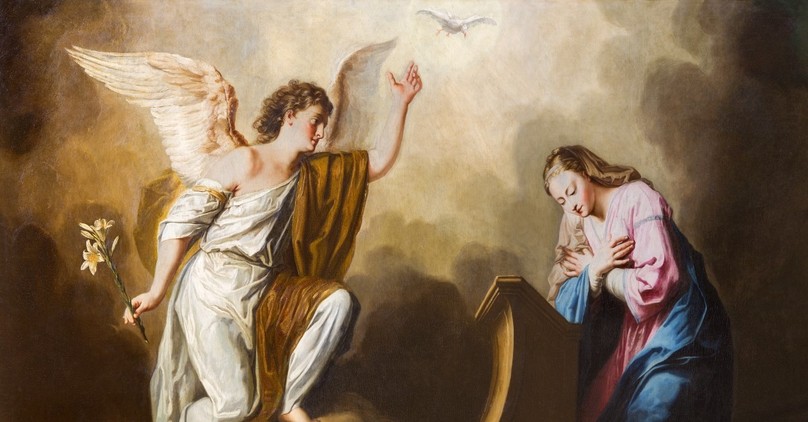
There is a lot of curiosity around angels, and perhaps one of the most popular angels found in Scripture is the angel Gabriel. He is often referred to as the “Archangel Gabriel,” although he isn’t explicitly called an “archangel” in Scripture—that title is reserved solely for Michael in Jude 9. Who was Gabriel? How did he interact with humanity throughout the Bible? He is explicitly named in the Bible only four times; however, contextually, Gabriel’s cameos carry great significance.
We see Gabriel as an angel who communicates on behalf of God—a messenger. It is interesting to note that Gabriel’s Old Testament appearances are with the prophet Daniel and convey the themes of repentance and judgment, while his New Testament appearances announce the entrance of salvation into the world.
Let’s explore Gabriel's Old and New Testament appearances.
Bible Verses That Mention the Angel Gabriel
1. Gabriel interprets Daniel’s vision of the ram and the goat in Daniel 8.
- Daniel 8:15 When I, Daniel, had seen the vision, I sought to understand it. And behold, there stood before me one having the appearance of a man.
- Daniel 8:16 And I heard a man’s voice between the banks of the Ulai, and it called, “Gabriel, make this man understand the vision.”
- Daniel 8:17 So he came near where I stood. And when he came, I was frightened and fell on my face. But he said to me, “Understand, O son of man, that the vision is for the time of the end.”
- Daniel 8:18 And when he had spoken to me, I fell into a deep sleep with my face to the ground. But he touched me and made me stand up.
- Daniel 8:19 He said, “Behold, I will make known to you what shall be at the latter end of the indignation, for it refers to the appointed time of the end.”
- Daniel 8:26 The vision of the evenings and the mornings that has been told is true, but seal up the vision, for it refers to many days from now.
2. Gabriel helps Daniel understand the revelation behind the prophecy of the seventy weeks in Daniel 9.
- Daniel 9:21 While I was speaking in prayer, the man Gabriel, whom I had seen in the vision at the first, came to me in swift flight at the time of the evening sacrifice.
- Daniel 9:22 He made me understand, speaking with me and saying, “O Daniel, I have now come out to give you insight and understanding.”
- Daniel 9:23 At the beginning of your pleas for mercy a word went out, and I have come to tell it to you, for you are greatly loved. Therefore consider the word and understand the vision.
- Daniel 9:24 Seventy weeks are decreed about your people and your holy city, to finish the transgression, to put an end to sin, and to atone for iniquity, to bring in everlasting righteousness, to seal both vision and prophet, and to anoint a most holy place.
- Daniel 9:25 Know therefore and understand that from the going out of the word to restore and build Jerusalem to the coming of an anointed one, a prince, there shall be seven weeks. Then for sixty-two weeks it shall be built again with squares and moat, but in a troubled time.
These two interactions with Gabriel are solely with Daniel, and Gabriel acts as an interpreter to help Daniel understand the implications of his dreams and visions. It’s not until centuries later that we once again see the return of Gabriel as he appears to the priest Zechariah and foretells John the Baptist’s birth. Interestingly, this is also where Gabriel identifies himself by his name and expresses his position as standing “in the presence of God.”
3. Gabriel announces the birth of the forerunner of Christ: John the Baptist in Luke 1.
- Luke 1:11 And there appeared to him an angel of the Lord standing on the right side of the altar of incense.
- Luke 1:13 But the angel said to him, “Do not be afraid, Zechariah, for your prayer has been heard, and your wife Elizabeth will bear you a son, and you shall call his name John.”
- Luke 1:18 And Zechariah said to the angel, “How shall I know this? For I am an old man, and my wife is advanced in years.”
- Luke 1:19 And the angel answered him, “I am Gabriel. I stand in the presence of God, and I was sent to speak to you and to bring you this good news.”
- Luke 1:20 And behold, you will be silent and unable to speak until the day that these things take place, because you did not believe my words, which will be fulfilled in their time.
4. Gabriel then announces the birth of Jesus to Mary, also in Luke 1.
- Luke 1:26 In the sixth month the angel Gabriel was sent from God to a city of Galilee named Nazareth,
- Luke 1:27 to a virgin betrothed to a man whose name was Joseph, of the house of David. And the virgin’s name was Mary.
- Luke 1:28 And he came to her and said, “Greetings, O favored one, the Lord is with you!”
- Luke 1:30 And the angel said to her, “Do not be afraid, Mary, for you have found favor with God.”
- Luke 1:31 And behold, you will conceive in your womb and bear a son, and you shall call his name Jesus.
- Luke 1:35 And the angel answered her, “The Holy Spirit will come upon you, and the power of the Most High will overshadow you; therefore the child to be born will be called holy—the Son of God.”
- Luke 1:37 For nothing will be impossible with God.
- Luke 1:38 And Mary said, “Behold, I am the servant of the Lord; let it be to me according to your word.” And the angel departed from her.
The Significance of the Angel Gabriel in Scripture
Gabriel’s appearances in Scripture are tied to turning points in God’s plan, and he carries key messages that will impact the course of the future. We don’t see Gabriel portrayed as a warrior, server of judgment, or an angel who is gathered around the throne of God, praising and worshipping. Instead, and unlike the angel Michael, Gabriel’s primary role is one of revelation and message. He makes it very clear in Luke that he is sent by God and is accustomed to standing in the presence of God. This claim suggests an element of rank, indicating that he is not just a messenger but is specifically sent by God. To doubt Gabriel’s message is, in essence, to doubt God Himself. Because of this statement by Gabriel, it is a reason why traditions often consider Gabriel as an archangel or a chief of messengers.
Outside of these four interactions, split between the Old and the New Testaments, there is no other mention of Gabriel by name in Scripture. His popularity as an angel has been primarily due to his role in the Christmas narrative foretelling the birth of Jesus, and because of this, his role in the prophetic visions of Daniel is often overlooked by the average Bible reader. However, his interaction with Daniel carries significant weight not just in foreshadowing the need for the Savior that Gabriel would later announce, but also in the doomed state of man and the judgment that is to come in the absence of repentance.
Jaime Jo Wright is an ECPA and Publisher’s Weekly bestselling author. Her novel “The House on Foster Hill” won the prestigious Christy Award and she continues to publish Gothic thrillers for the inspirational market. Jaime Jo resides in the woods of Wisconsin, lives in dreamland, exists in reality, and invites you to join her adventures at jaimewrightbooks.com and at her podcast madlitmusings.com where she discusses the deeper issues of story and faith with fellow authors.
SHARE


