
I stumbled down the concrete steps of my grandparents’ farmhouse toward the yellow school bus perched at the end of the driveway. The dust swirling in its wake seemed reminiscent of the sexual shame filling my mind. Hazy. Turbid.
Entering the safe confines of the cone-shaped vehicle, I realized nobody knew my stepfather had assaulted me moments before their arrival.
An Important Distinction: The Difference between Sexual Sin and Sexual Abuse
That day untethered the strength I'd needed. It launched me on the long, arduous journey of healing from sexual abuse. Perhaps you, a friend, or a loved one, is forging a similar path toward healing. I am deeply sorry for your pain. I want to reassure you that healing after sexual abuse is possible.
Because most survivors blame themselves for the abuse, it’s imperative to recognize the difference between sexual sin and sexual abuse. The National Sexual Violence Resource Center provides a helpful definition: “Sexual abuse occurs when a person knowingly causes another person to engage in a sex act by threatening or placing the other person in fear, or if someone engages in a sexual act with a person who is incapable of appraising the act, or unable to give consent.”
Author and psychologist Dan B. Allender writes, “It seems many people operate on the principle that whatever happened to them is not abuse, but if it had happened to someone else, or if it had been a bit more extreme, then it would have been abusive.”
You may need to hear this. Those terrifying moments etched in your mind? The emotional pain haunting your steps? The shame you feel because he or she touched you that way? You are not at fault.
While sexual abuse involves one person forcing another to gratify his or her sexual demands without regard for age, gender, race, or ability to consent, sexual sin is a personal, deliberate decision to ignore the commands God outlines in the Bible.
Hebrews 13:4 (MSG) reminds believers that God established sexual standards to protect the beauty and intimacy enjoyed by a committed couple, “Honor marriage, and guard the sacredness of sexual intimacy between wife and husband."
God draws a firm line—prohibiting casual and illicit sexual activity. Both the Old and New Testaments warn us to avoid all types of sexual immorality, including, but not limited to:
- adultery (Exodus 20:14, Proverbs 6:32).
- incest (1 Corinthians 5:1).
- promiscuity (Ephesians 5:3).
- homosexuality (Romans 1:27).
- lust (Matthew 5:27-28).
Sadly, a strong link exists between childhood sexual abuse and a pattern of sexual addiction later in life.
Though sexual sin and sexual abuse differ, both result in long-term impact. Counselor Josh Spurlock shares, “Sex has a way of reaching deeper than behavior. It touches attachment, trust, vulnerability, identity, and shame.”
Before you read any further, allow me to reaffirm that through Christ’s death and resurrection, you were set free of condemnation. There is no sin too grievous that He is unwilling to forgive—including sexual sin.
Friend, invite Christ to loosen the graveclothes of shame—whether they resulted from abuse, sin, or both.
What Does the Bible Say about Shame and Healing?
In her article, "The Struggle with Shame," Jennifer Maggio explores the distinctions between guilt and shame. If you experienced the fear and horror of abuse, you may relate to her words. “Guilt says, ‘I did something bad.’ Shame says, ‘I am someone bad.’ Shame becomes guilt on steroids. It becomes a badge we wear that we accept as defining who we are.”
As survivors, we too often accept the label and allow sexual abuse to determine personal value.
But shame, fear, and hiding were never a part of His plan. They were consequences of our poor choices and decisions—or an outcome of the evil done against us.
Jesus’s death stripped shame of its power. Hebrews 12:2 reminds us that Christ “despised the shame” of the cross. The humiliation and suffering He endured paled in comparison to that which lay ahead—heavenly glory and the salvation of His children.
We, too, can overcome. Persevere. Shun shame and exchange the ashes of those detestable moments for a crown of beauty. (Isaiah 61:3 NIV)
What practical steps can someone struggling with shame take to be set free from its power?
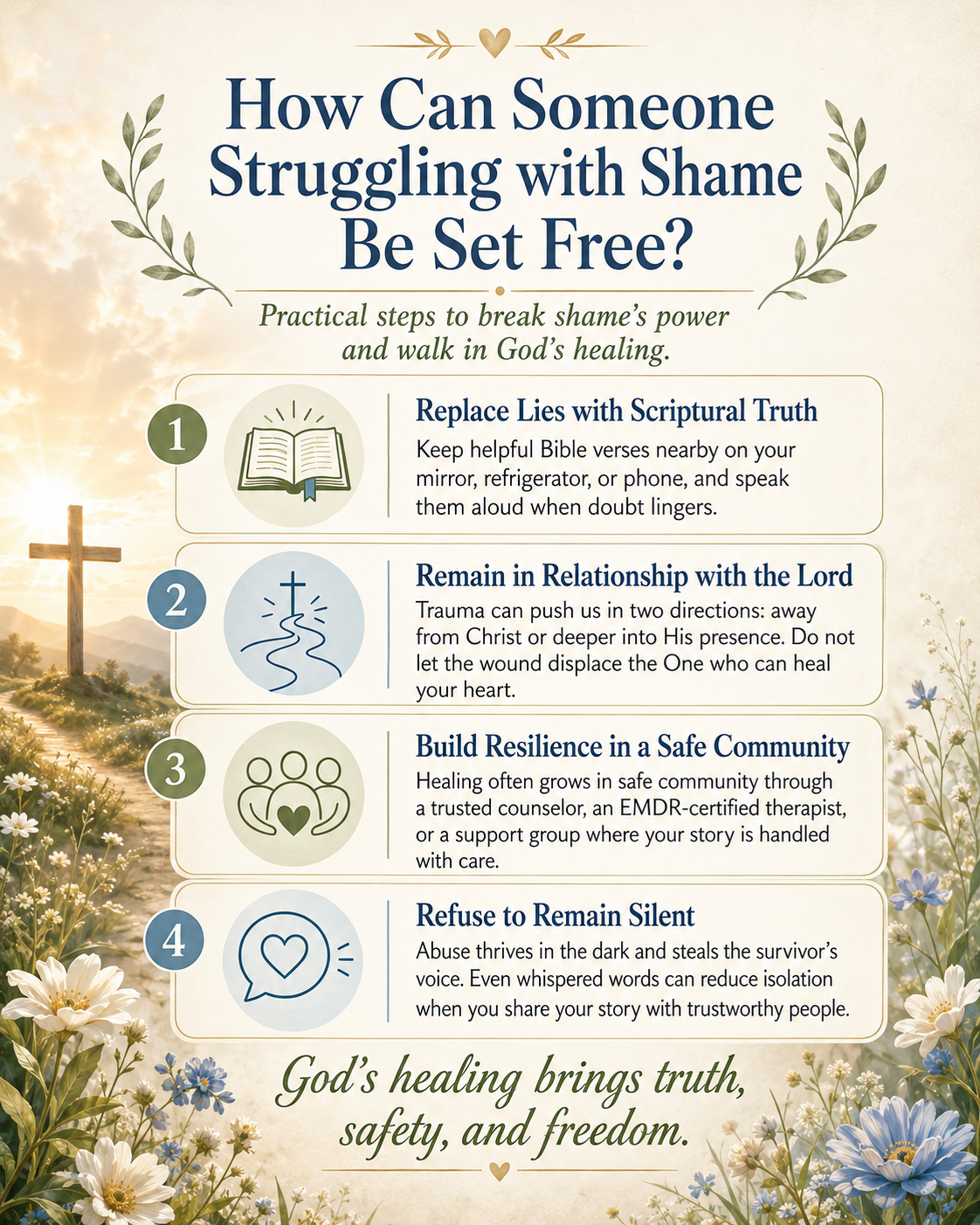
- Replace lies with scriptural truth. “Therefore, if anyone is in Christ, he is a new creation. The old has passed away; behold, the new has come" (1 Corinthians 5:17 ESV). When familiar phrases of self-condemnation, disgust, or hatred flood your mind, replace them with the truth of scripture. Keep helpful verses nearby—on your mirror, refrigerator, or phone—and speak them aloud when doubt lingers.
- Remain in relationship with the Lord. Trauma has two possible outcomes—we can turn away from Christ or seek shelter in His presence. If we allow the wound to displace the One who can heal our hearts? Satan wins.
- Build resilience in a safe community. Sharing your story with a reliable counselor, facilitated inner healing prayer, working with a therapist certified in EMDR, and joining a support group are all different ways in which safe community helps us heal from sexual abuse. Healing after sexual abuse sometimes feels impossible. It’s not. God proved that when He rescued me from the ravages of Complex Post Traumatic Stress Disorder. Whether you’re experiencing a handful of post-abuse symptoms or live with a full-blown struggle like PTSD, there is hope for healing.
- Refuse to remain silent. Abuse thrives in the dark and steals the survivor’s voice. But even whispered words about painful events reduce isolation when we share our story with trustworthy people.
We’ll explore why silence keeps sexual shame so powerful in the following section.
Why Silence Keeps Sexual Shame So Powerful
One study by the National Library of Medicine reports that “sexual shame has been found to be related to self-hostility, sexual and relational dysfunctions, body-shaming, aggression, hypersexuality and sexual addiction.”
Silence allows false beliefs about God, self, and others to fester—manifesting in harmful habits and hangups such as people-pleasing, addictive behaviors, and isolation. It traps the nervous system in the defensive cycles of flight, fight, freeze, and fawn. These natural responses to trauma once helped us survive untenable situations, but when our bodies remain stuck in trauma-response overdrive, we are susceptible to physical and mental health problems.
The undisclosed anguish of sexual shame and abuse keeps us from experiencing the empathy of others who understand our pain, anger, and grief. But sharing with safe people loosens the stronghold of shame and invites the balm of compassion into the broken places.
Not only does the expression of our pain help us heal from sexual abuse, but the Word also comforts and strengthens us.
Bible Verses about Shame, Forgiveness, and Healing
Feelings of defeat and fear will wage war against the idea that we can heal from sexual abuse. But the Lord provides the weapons we need to fight the enemy’s lies. When doubt and overwhelm threaten to overcome our strides toward healing, His word cuts through difficult emotions and bolsters us with truth.
Some of the verses I’ve found most helpful in my own journey are listed below.
- Psalm 34:4-5 (ESV) "I sought the Lord, and he answered me and delivered me from all my fears. Those who look to him are radiant, and their faces shall never be ashamed."
- Romans 10:11 (ESV) "There is therefore now no condemnation for those who are in Christ Jesus."
- Zephaniah 3:19 (ESV) "Behold, at that time I will deal with all your oppressors. And I will save the lame and gather the outcast, and I will change their shame into praise and renown in all the earth."
- Isaiah 53:5 (ESV) "But he was pierced for our transgressions; he was crushed for our iniquities; upon him was the chastisement that brought us peace, and with his wounds we are healed."
- Romans 12:17 (ESV) "Repay no one evil for evil, but give thought to do what is honorable in the sight of all."
- 1 Peter 3:9 (ESV) "Do not repay evil for evil or reviling for reviling, but on the contrary, bless, for to this you were called, that you may obtain a blessing."
- Jeremiah 17:4 (ESV) "Heal me, O Lord, and I shall be healed; save me, and I shall be saved, for you are my praise."
- 1 Peter 2:24 (ESV) "He himself bore our sins in his body on the tree, that we might die to sin and live to righteousness. By his wounds you have been healed."
- Psalm 147:3 (ESV) "He heals the brokenhearted and binds up their wounds."
- Malachi 4:2 (ESV) "But for you who fear my name, the sun of righteousness shall rise with healing in its wings. You shall go out leaping like calves from the stall."
The Importance of Counseling and Safe Christian Community
I mentioned the importance of Christian counseling earlier in this article, and I can’t emphasize it enough. Healing remains out of reach unless and until we seek support in a safe, confidential community. If you haven’t yet attended church regularly, I encourage you to get involved in a safe church community.
I also discovered that meeting with and interviewing three or four faith-based counselors who specialize in trauma gave me the opportunity to gauge my comfort level with potential therapists.
Questions worth asking include:
- What are your credentials and/or training?
- Do you specialize in counseling clients with sexual trauma?
- What modalities do you employ (i.e. EMDR, CBT, inner healing prayer)?
- How often will we meet?
More than anything else, it’s vital that you trust your therapist with every aspect of healing—including those that involve marriage, dating, child-rearing, or friendships.
What if Your Past Still Affects Your Marriage, Dating, or Friendships?
The tentacles of sexual abuse weave their way into almost every area of life, including the relationships we most cherish. Survivors sometimes struggle with:
- developing healthy boundaries
- attachment issues
- addictions (i.e. sexual addictions, substance abuse)
- avoidance/fear of relational and/or physical intimacy
- trusting others
Survivors long to escape the past, but healing only occurs when we face our pain-laden histories. If you struggle with one or more of the areas listed above, refuse to allow abuse to have the last word. Grab hold of God’s promises. Wrestle with the memories. Do the hard work. You and your loved ones are worth fighting for.
A Prayer for Healing after Sexual Abuse
Father, sexual abuse digs its hard-edged pain deep into the soul, but You are El Roi. The God who sees everything—including our deep, inner scars. Reach into those places where the pain hides and transform the “mourning into joy”. (Jeremiah 31:3)
Go before and behind Your child through the healing wilderness, and deliver them to wide, open spaces.
In the name of Jesus Christ who binds up our wounds,
Amen.
Conclusion: Shame Does Not Get the Final Word
The Lord, who overcame the grave, will strengthen you as He plants hope in your heart and stiches the hurting places with His tender mercy and healing power.
Yes, healing is a journey. But over the horizon? Joy. Freedom. Peace. Beloved of God, you can withstand and conquer shame; it does not get the final word.
Photo Credit: ©iStock/Getty Images Plus/mapo


